

Key takeaways
- Every shot is played twice: first in your head, then with the club. The plan decides the shot before the swing does.
- An avoidance thought like “just not left” keeps the hazard at the centre of your attention, and research on putting under pressure points the same way.
- A swing thought adds information. An anchor removes a decision, and it is chosen before the situation arrives.
- For your next round: on every tee, say where the ball is going, never where it should not go.
The November 2026 issue of Golf Digest Middle East carries an article I wrote for its Mind Games section: “Boring Golf is Good Golf. Your Mind Should Be Boring, Too”, on pages 22 and 23. It is about the thought that arrives on the tee before any other, and why the fewer thoughts you bring to a pressure shot, the freer you swing.
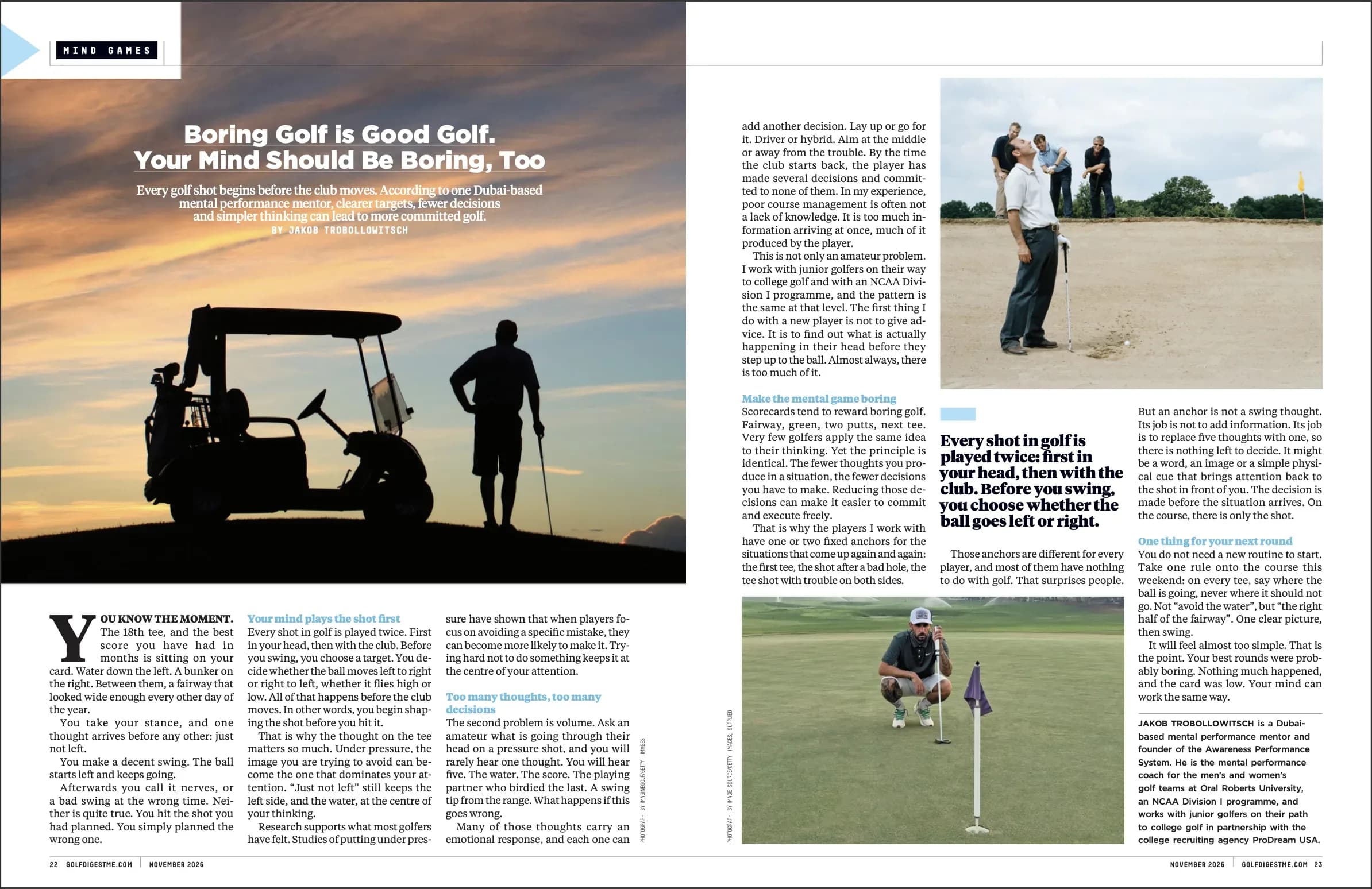
You can read the full article in the magazine. Get the November 2026 edition of Golf Digest Middle East. This post is not a copy of it. It picks up three questions the printed page had no room for.
What does the Golf Digest Middle East article say?
In short, four things:
- Every shot is played twice: first in your head, then with the club. The target, the shape and the height are chosen before the club moves.
- The thought you are trying to avoid can become the one that steers you. “Just not left” still keeps the left side, and the water, at the centre of your attention.
- The second problem is volume. On a pressure shot most players carry five thoughts, not one, and each of them can add another decision.
- The answer is not a new thought. It is fewer. One or two fixed anchors for the situations that keep coming back replace five thoughts with one.
The scene the article opens with is one most club golfers know. The 18th tee, the best card in months, water down the left, a bunker on the right. One thought arrives first: just not left. You make a decent swing, and the ball starts left and keeps going. You hit the shot you had planned. You simply planned the wrong one.
Why does “just not left” so often go left?
The article mentions research on putting under pressure. The best known study behind that line is “The Putt and the Pendulum” by Daniel Wegner, Matthew Ansfield and Daniel Pilloff, published in Psychological Science in 1998 (DOI 10.1111/1467-9280.00037). Golfers who were told not to overshoot a putt tended to overshoot it more when they were under extra mental load. Trying hard not to do something kept it in the middle of their attention.
On the course, the load is never missing. The score, the playing partner, the swing tip from the range. So the instruction your mind hears on that 18th tee is not “right half of the fairway”. It is “water”, with a word of negation in front of it that pressure tends to drop.
So the useful question on the tee is where the ball is going. Everything else is information your system has to process and then ignore, and ignoring costs attention too.
Is an anchor just another golf swing thought?
No. A swing thought adds information: keep the head still, finish high, turn through. Even a good one is one more thing to monitor while the club is moving. An anchor has the opposite job. It does not add anything. It removes the decision, so there is nothing left to decide over the ball.
That is also why most anchors have nothing to do with golf. It might be a word, an image or a simple physical cue that brings attention back to the shot in front of you. What matters is that it was chosen before the situation arrived. On the first tee, after a bad hole, or with trouble on both sides, the player does not search for the right thought. It is already there.
In my own method this sits inside the Set & Forget protocol: you anchor the shot and commit to the plan, then you step over the ball and let the trained body execute, then you accept the result as data. The anchor belongs to the first step. Doubt and re-evaluation happen there, or not at all.
What can you take onto the course this weekend?
One rule, from the end of the article. On every tee, say where the ball is going, never where it should not go. Not “avoid the water”, but “the right half of the fairway”. One clear picture, then swing.
Say you play a round with that rule and nothing else. No new routine, no new swing feel. On the holes where you catch yourself thinking about the trouble, do not fight the thought. Name the target out loud instead, and only then take your stance. It will feel almost too simple. That is the point. Your best rounds were probably boring too: nothing much happened, and the card was low.
If the same moment keeps costing you shots in competition, the first tee, the hole after a double, the short putt that matters, that is what I call the Execution Barrier. Finding exactly where it switches on is the work of Phase 1, the Execution Barrier Audit.
Where can you read the full article?
In the November 2026 issue of Golf Digest Middle East, pages 22 and 23. Get your copy here. My thanks to the editorial team for the space, and for letting me share the pages here.

Written by Jakob
Golf Mental Coach · Dubai
Handicap 2. Works exclusively with competitive and professional golfers. Eight years of dedicated study in applied sports psychology, awareness practice, and inner engineering.