
Jakob — Mental Performance Mentor

About Jakob

I know what it costs to have the talent — and not the tools.

My name is Jakob. I work out of Dubai with college athletes and tour professionals who have one thing in common: the skill is there, the scorecard is not.

I built the Awareness Performance System because I lived the exact problem it solves. Not in golf — in football. But the pattern is the same.

The Academy Years

Seven sessions a week. Zero sessions for the mind.

I entered the Austrian football academy system at fifteen. Seven training sessions a week. Coaches who could break down technique to the millimeter — foot position, hip rotation, timing of the pass. Technically, I was prepared for anything the pitch could throw at me.

None of them ever taught me what to do inside my head.

When the pressure came — a selection match, a trial in front of scouts, a game where the result actually mattered — something shifted. The same body, the same technique, the same preparation. But a different player. Tighter. More hesitant. Reactive instead of instinctive.

I didn't have the language for it then. Today I call it the Execution Barrier. Back then, I just called it choking. And nobody around me knew how to fix it — because they were all focused on the hardware.
The Eight Years Between

I never made it to the top of professional football. That failure taught me everything.

When my football career ended — not because of a lack of talent, but because the mental architecture was never installed — I started a different kind of training. Eight years of dedicated study in applied sports psychology, awareness practice, and inner engineering.

I studied Timothy Gallwey's Inner Game — the foundational framework that separates the thinking self from the performing self. I studied Bob Rotella's work on golf psychology and pre-shot commitment. I studied Joseph Parent's Zen Golf — the application of non-judgmental awareness to competitive sport. And I went deeper: into Sadhguru's Inner Engineering, the technology of managing internal states independently of external circumstances.

Each of these thinkers illuminated a different facet of the same problem. None of them, individually, had built a complete system for competitive athletes. That became my work.

Why Golf. Why Dubai. Why Now.

Golf is the sport where the mental game has nowhere to hide.

In team sports, the team absorbs the pressure. A bad play gets covered by a teammate's recovery. In golf, there is no team. There is no coach walking next to you between shots. Every reaction — to a bad lie, a missed putt, a hostile leaderboard — is yours alone.

That makes golf the purest test of mental architecture. And it makes it the sport where the Awareness Performance System produces the most visible, measurable results.

Dubai is home because the competitive golf ecosystem here is extraordinary — Asian Tour events, world-class practice facilities, and a concentration of serious golfers training year-round. It is the right place to do this work at the highest level.

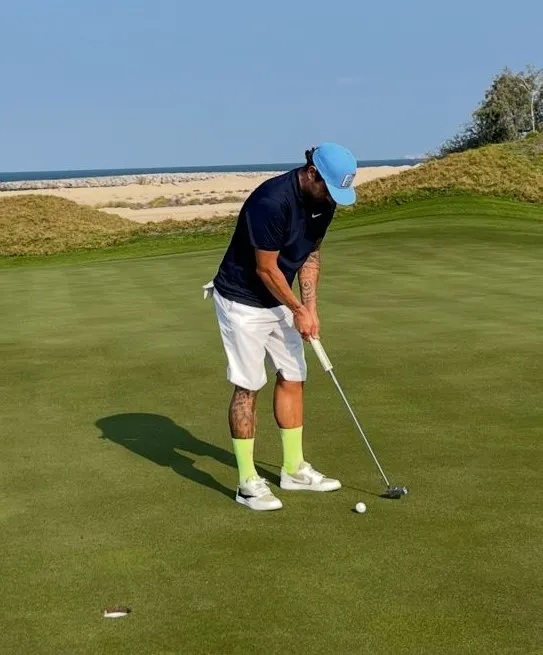
Jakob on the course in Dubai

The Teachers

What I learned from each one.

Tim Gallwey

The separation between Self 1 (the thinker) and Self 2 (the performer). The discipline of letting go. The equation that changed everything: P = p − i.

Bob Rotella

The pre-shot routine as a commitment device. The discipline of staying in the present shot. The courage to commit fully before every swing.

Joseph Parent

Non-judgmental awareness as a performance technology. The bridge between Eastern wisdom and Western competitive sport. Seeing clearly without labeling.

Sadhguru

The deepest layer. Managing inner states independently of outer circumstances. The ultimate competitive advantage: internal stability regardless of context.

How I Work

A typical day. A typical session.

I start every day on the course — not coaching, but playing. I maintain a handicap of −2 because I believe you cannot teach a system you do not use yourself. If APS does not work under my own competitive pressure, it has no business being in someone else's game.

A typical session with a client lasts 60 to 75 minutes. We begin with a structured check-in — not "how do you feel?" but "what happened on the last three holes after your first bogey?" The questions are diagnostic. The answers reveal the patterns.

From there, we work on the specific protocol that addresses the identified pattern. Sometimes it is an identity recalibration. Sometimes it is a pre-shot anchor overhaul. Sometimes it is a direct intervention in the judgment loop that fires during the downswing. Every session has a single, clear objective.

I work with 8 to 12 athletes at any given time. That is a deliberate constraint. This work requires full attention, and I will not dilute it.

If this resonates — initiate a Discovery Audit.
We will find out if we are a fit.

[ Initiate Discovery Audit ] No pitch. No pressure. 30 minutes.