Case Studies
In practice.
What this looks like.
Real cases. Real patterns. Real outcomes. Names are anonymized. The work is not.
"Six weeks in, I shot the best competitive round of my career — not because I swung differently. Because I finally stopped fighting myself."
Cindy
Junior EliteThe Player
Junior elite golfer competing at the highest national level. Technical skill at the top percentile of her age group. Tournament results inconsistent with practice performance.
The System Failure
At her level, technique was the entry fee. Everyone had it. The differentiator was who could quiet the mind when the leaderboard tightened. Cindy's pattern was classic: strong starts followed by defensive retreats the moment she moved into contention. Her mental system treated success as a threat rather than a baseline.
The Discovery
Phase 1 revealed an identity ceiling. Cindy still identified as "a good player who sometimes plays great" rather than "a great player who sometimes has off days." Every strong round triggered an unconscious expectation of regression — the system was self-correcting downward.
The Installation
We installed the Set & Forget protocol and rebuilt her pre-shot routine from the ground up. The thinking mind was given a clear, time-limited job — and a defined moment to let go. Simultaneously, we recalibrated her internal identity standard: elite performance became the expectation, not the exception.
The Result
She stopped trying to be tougher. She started being more present. The defensive retreat disappeared. The score followed — not because she swung differently, but because her internal system stopped interfering with what her body already knew how to do.
Jake
College AthleteThe Player
College-level competitive golfer. Consistently in contention through three rounds. Pattern: final-round collapse in four out of five tournaments. Top 10 becoming Top 25 with alarming regularity.
The System Failure
Jake's Execution Barrier was triggered by a single bad hole. One bogey — sometimes one bad shot — pushed his internal system into Survival Mode. He shifted from attacking the course to protecting a number. The remaining holes were played from a defensive position, and the scorecard reflected it.
The Discovery
Phase 1 mapped the exact thought-pattern that triggered the downward spiral. The sequence was identifiable: bad shot → immediate self-judgment ("there I go again") → body tension in shoulders and grip → overcontrolled swing → second bad shot → spiral confirmed.
The Installation
We installed a hard-reset protocol — a three-breath anchor tied to a physical cue that interrupted the judgment loop within seconds. The protocol worked at the point of the trigger, not after the spiral had already begun. We also rebuilt Jake's relationship with bogeys: a bogey became a data point, not a threat to identity.
The Result
Scoring average on holes following a bogey dropped by 1.4 strokes within four weeks. The blow-ups stopped. Jake's final-round average improved from his worst round to his second-best round within two months of completing Phase 2.
Langston
College RecruitThe Player
Three state titles. Range talent in the top percentile. Being scouted by Division I programs. And consistently three to four shots left on the course every round when scouts were watching.
The System Failure
Langston's pattern was not tactical — it was identity-driven. He identified as "the state champion" — which sounds like a strong identity until you realize it created a ceiling. State champion was his peak expectation. Every performance above that level was experienced as luck, not baseline. He played up to his identity and no further.
The Discovery
Phase 1 revealed the Identity Ceiling in its clearest form. When Langston hit a world-class shot in front of a scout, his internal response was surprise — not confirmation. The system read it as anomaly, not norm. Every subsequent shot was an unconscious attempt to return to "normal" — which was below what he was capable of.
The Installation
We rebuilt the underlying identity standard before touching anything else. The work was not about adding technique or adding confidence. It was about recalibrating the system's internal baseline. "State champion who got recruited" became "recruited athlete who knows his level."
The Result
He stopped playing like a state champion who got recruited. He started playing like a recruited athlete who knew his level. The three to four shots left on the course disappeared — not because his technique changed, but because his identity standard matched his physical capability.
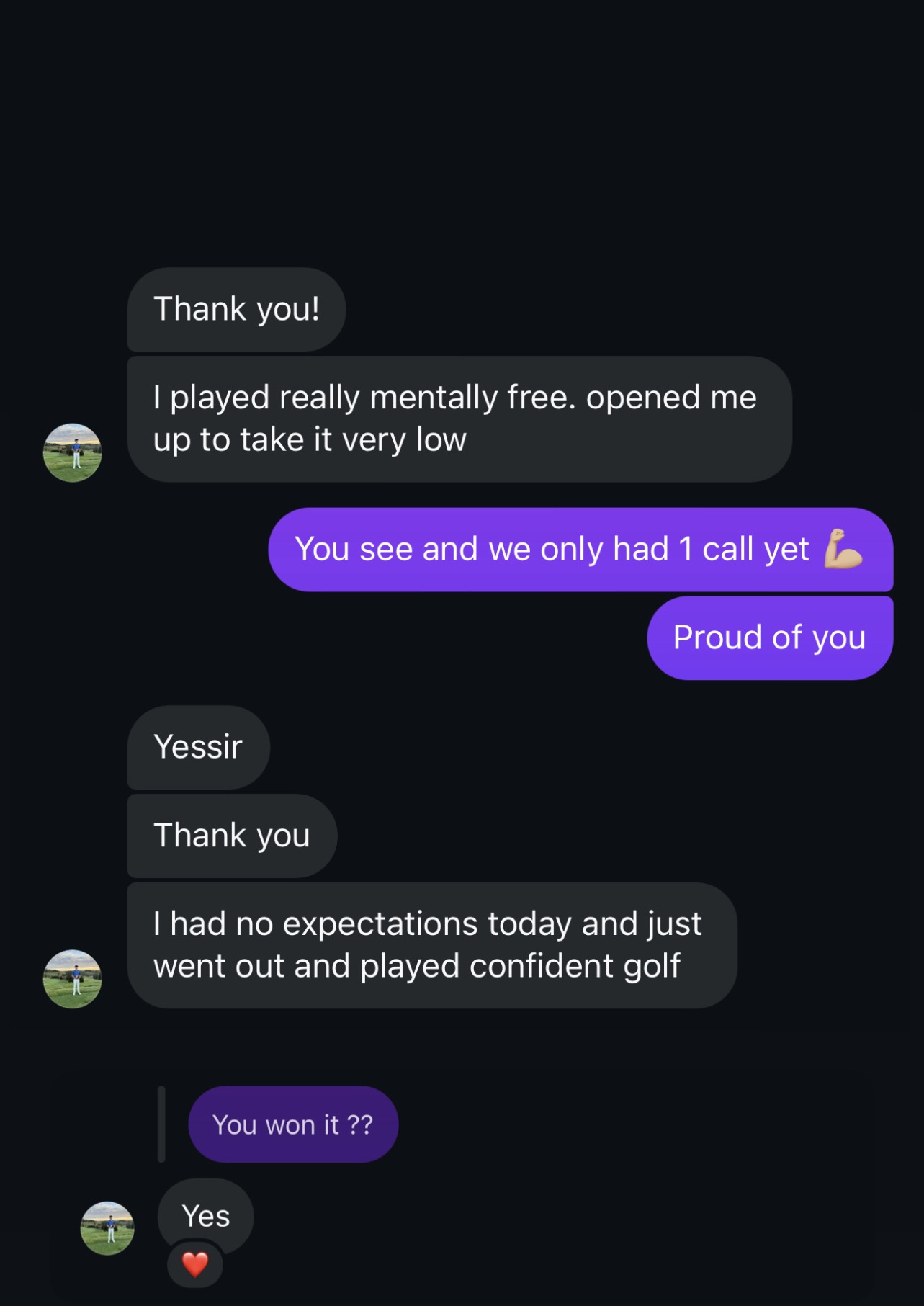
Raw Feedback
Direct messages from players running the system under competitive pressure.